The Patience of Others: How The Macallan's Collector Ranges Came to Exist
Whisky
Market
Portfolio Strategy
⊹
Dec 1, 2025
The Macallan's collector ranges have defined what ultra-premium whisky collecting looks like. Fine & Rare, the Six Pillars in Lalique, and the Red Collection dominate auction results, set records, and provide the template that other distilleries attempt to emulate. In 2024, Macallan bottlings accounted for 13 of the 20 highest hammer prices at auction. The Fine & Rare 1926 Valerio Adami holds the record for the most expensive bottle of whisky ever sold, at £2.7 million. Complete sets of the Six Pillars trade above $600,000. The Red Collection 60-Year-Old appeared four times in last year's list of highest hammer prices, with results reaching $162,889.
The assumption, reasonably enough, is that collections of this calibre reflect decades of strategic planning. That somewhere in Speyside, generations of Macallan custodians laid down casks with the foresight to know they would be bottled 60, 70, or 78 years later as the centrepieces of prestige ranges.
The reality is different. These collections did not emerge from inventory planning or demand forecasting conducted half a century in advance. They exist because Macallan, like most Scottish distilleries, historically sold excess spirit into the wholesale cask market. Independent bottlers and merchants bought this stock and had the patience to hold it for decades. In some cases, nearly a century. The shape of each collection is determined not by what Macallan planned but by what happened to be available to bring home.
The Industry Practice That Made It Possible
For much of the twentieth century, Scottish distilleries routinely sold excess new make spirit and young casks to independent bottlers, blenders, and wholesalers. This was practical economics, not strategic error. Distilleries operate most efficiently when they are producing regularly scheduled volumes of spirit. However, the maturation of whisky ties up capital for years or decades before generating revenue. Independent industry participants provided liquidity by purchasing stock that was in excess of the distillery's own needs or didn't have immediate demand from the large blending houses.
Gordon & MacPhail, established in Elgin in 1895, became one of the largest and most significant holders of aged Scotch whisky in the world through this practice. The firm accumulated casks from distilleries across Scotland, including substantial holdings from Macallan. Other merchants and independent bottlers did the same, building inventories that would prove extraordinarily valuable as the market for aged single malt developed.
The independents had something that distilleries often lacked: warehousing capacity, patient capital, and time horizons measured in generations rather than quarterly reports. Stock was held for 50, 60, 70 years and beyond, far exceeding what most producers planned for. These buyers became, in effect, custodians of whisky history, holding liquid that the original distillers never expected to see again.
Gordon & MacPhail's Speymalt range from the Macallan Distillery illustrates this dynamic. The range includes whiskies aged up to 70 years, distilled at Macallan in the 1940s and 1950s, available at a fraction of the price commanded by official Macallan releases. The liquid is comparable; the difference lies in the label and the collection framework. For connoisseurs seeking to taste whisky from Macallan's mid-century production, the independents offer an accessible route. For collectors building portfolios with resale value, the official releases command the premium.
Fine & Rare: The Template for Buyback
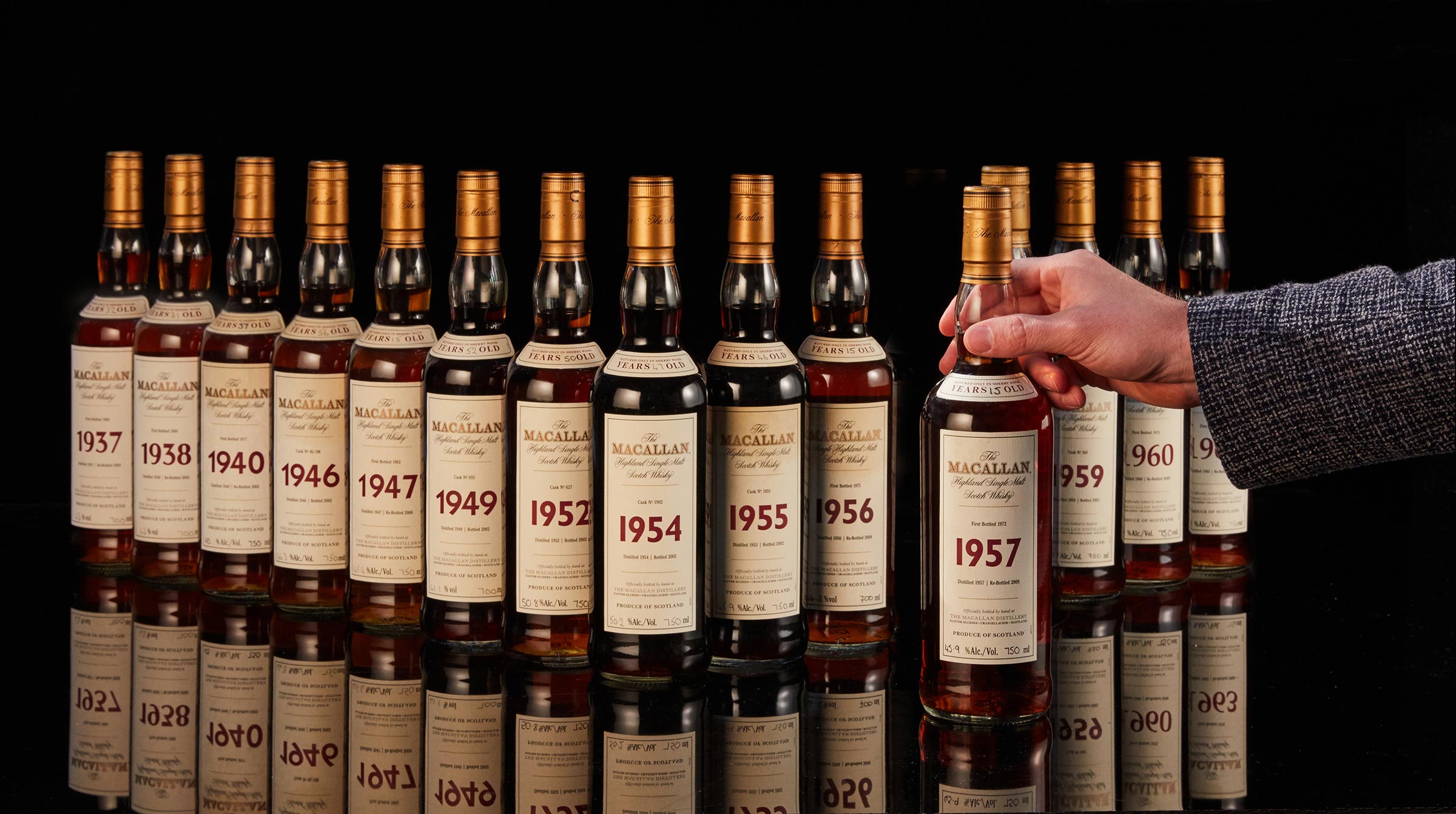
The Fine & Rare Collection, launched in 2002, established the template for everything that followed. The collection began with 37 bottlings and has since grown to 60 expressions, spanning vintages from 1926 to 2000. It remains the largest assembly of vintage-dated single malt whiskies from a single distillery in the world.
The collection was conceived by David Cox, then Macallan Director, with the explicit goal of creating a vintage library to rival the finest wine collections. Each bottle is vintage-dated, predominantly drawn from single casks, offering collectors a journey through eight decades of Macallan's history.
Crucially, not all Fine & Rare bottlings originated in Macallan's own warehouses. Some were bought back from private collections and independent bottlers, then rebottled under the Fine & Rare label. The 1937 37 Year Old provides a striking illustration. This whisky was originally bottled by Gordon & MacPhail under the Macallan-Glenlivet name in 1974, when licensing laws permitted such dual branding. When Macallan launched Fine & Rare in 2002, the company bought back some of these Gordon & MacPhail bottlings, rebottled them with the Fine & Rare label, and re-released them as part of the series.
The market differential is instructive. The original Gordon & MacPhail bottling of the 1937 trades at auction for approximately £3,500. The same liquid, rebottled as Fine & Rare, commands nearly £34,000. This tenfold premium reflects the value of Macallan's brand and also the membership in a coherent, prestigious collection. But it also reveals the origin of the stock: whisky that left Macallan's control decades ago, held by others, and subsequently recovered.
The apex of Fine & Rare is the 1926 vintage, bottled in 1986 after 60 years of maturation. Only 40 bottles were produced from cask number 263. These were never sold at retail; Sotheby's notes they "were reportedly not made available for public purchase; instead, some were offered to The Macallan's top clients." The bottles received different label treatments over subsequent years: 12 designed by Sir Peter Blake in 1986, 12 by Valerio Adami in 1993, and 14 with the standard Fine & Rare label when the collection launched in 2002.
The first recorded auction sale of a 1926 bottle was $6,000 in 1987. By 2023, the Valerio Adami version reached £2.7 million at Sotheby's London. The appreciation reflects not merely time and scarcity, but the cumulative effect of the Fine & Rare framework in establishing these bottles as the most desirable whiskies on earth.
Six Pillars in Lalique: Constraint and Appreciation
The Six Pillars in Lalique collection, released between 2005 and 2016, demonstrated a different approach: a closed series with a defined endpoint. The collaboration with French crystal house Lalique produced six decanters containing whiskies aged between 50 and 65 years, each celebrating one of Macallan's foundational "pillars": Exceptional Oak Casks, Natural Colour, Finest Cut, Curiously Small Stills, Spiritual Home, and Peerless Spirit.
The first edition, the 50-Year-Old, released in 2005, was limited to 470 individually numbered decanters. It launched at under €5,000. Today, the market value exceeds €100,000, representing an appreciation of more than 5,000%. The 62-year-old fifth edition, released in 2014 with an RRP of £16,000, now commands $35,000 to $40,000 at auction. Complete sets of all six decanters trade above $600,000, with a set selling at Sotheby's in April 2023 for that figure.
The brilliance of the series lay in its defined endpoint. From the outset, collectors knew there would be six decanters and no more. This clarity transformed the collection from a sequence of releases into a finite, completable set. In 2014, eight of the ten highest-priced bottles sold at auction were decanters from the Lalique collection. By 2015, Macallan was the most valuable whisky brand at auction, accounting for over 25% of total value traded.
The Six Pillars also demonstrated the potential for value creation from securing allocation at launch. Collectors who purchased across the decade, building their sets as each decanter was released, secured positions that would be prohibitively expensive to replicate today. The closed nature of the series means no further supply will ever enter the market.
Yet the stock that filled these decanters came from somewhere. The casks that yielded this liquid were not held in fifty year anticipation of a Lalique collaboration decades hence. They were held because someone, whether Macallan or an independent, had the patience and the warehousing to let them mature.
The Red Collection: Recovering What Remains
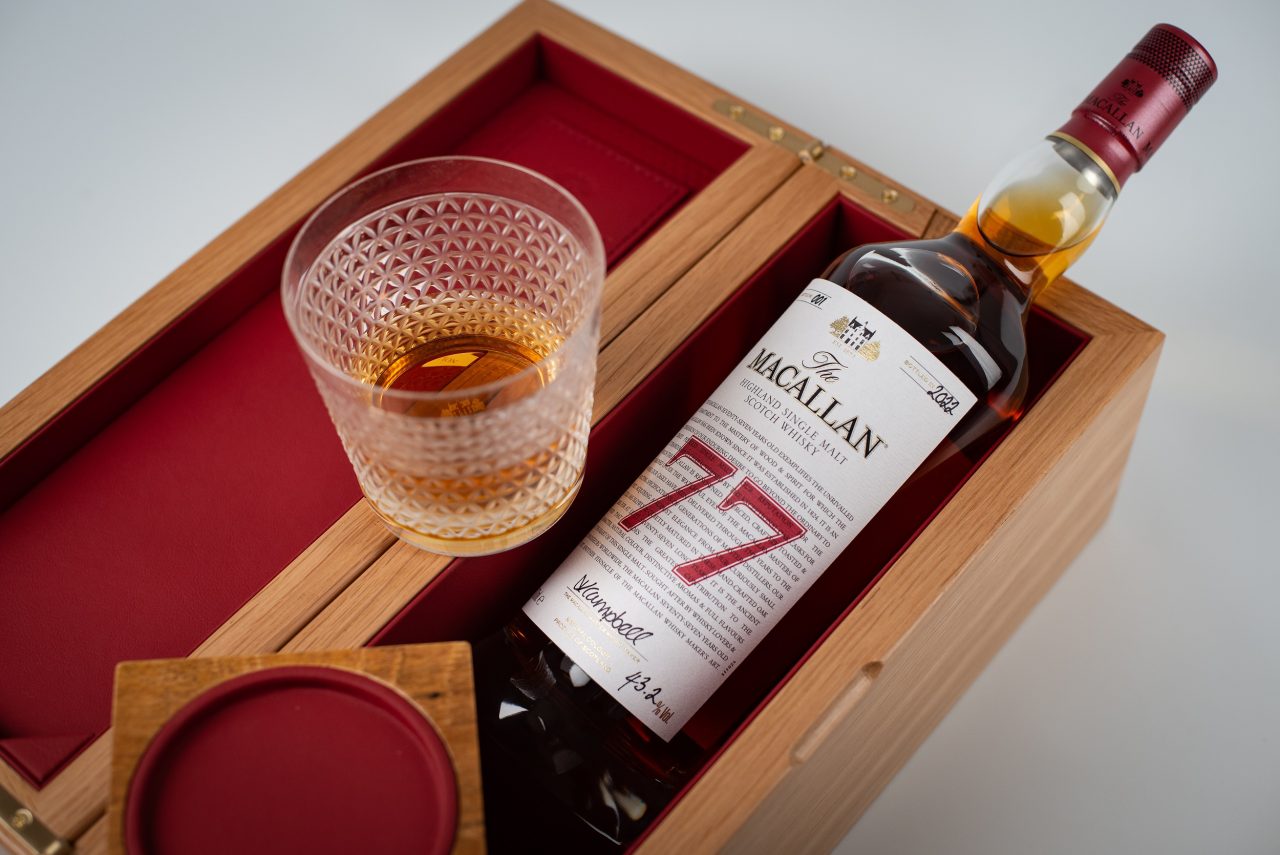
The Red Collection, launched in October 2020, represents Macallan's latest and potentially most significant expression of this phenomenon. The collection is anchored by three ongoing releases (the 40, 50, and 60 Year Olds, which Macallan has indicated it has sufficient stock to release annually), joined by periodic "guest releases" of even older whiskies: to date, bottlings at 71, 73, 74, 77, and 78 years old.
The launch was staged at Sotheby's Halloween sale, where a complete set of six bottles, illustrated and signed by Spanish artist Javi Aznarez, sold for £756,400 against a low estimate of £200,000. The 78-year-old in that set was, at the time, the oldest aged whisky ever offered at auction. The narrative framework centres on the colour red throughout Macallan's history: the founder Alexander Reid (meaning "the red one" in Scots) and the red ribbons used to mark vintage bottles in the 1980s.
Within the industry, the Red Collection is understood to have been assembled substantially from buyback stock. This is not criticism; it is simply how such collections come into being. Whisky distilled 70 or 78 years ago was not laid down with the Red Collection in mind. It was held by those with the patience and resources to wait, then recovered by Macallan and packaged into a coherent series.
The ongoing releases (40, 50, 60 years) imply continuity, but the guest releases depend entirely on what aged stock remains available. The 73-year-old, released in 2024 at $82,500 retail, was distilled in November 1950. There is only so much whisky from that era. Once it is bottled, no more can be made. Each guest release represents a further depletion of a finite and irreplaceable resource.
The End of an Era
With very few exceptions, Macallan stopped selling casks to third parties decades ago. The stock held by independents is finite and depletes with every bottling. Gordon & MacPhail continues to release aged Macallan under its Speymalt label, but these holdings are not inexhaustible. When the last casks are emptied, a chapter of whisky history closes permanently.
Future collections of the type that Fine & Rare, Six Pillars, and the Red Collection represent may not be possible, or may be far more limited in scope. Macallan now controls its own inventory from distillation through to bottling. Stock laid down today will mature under Macallan's sole custody. The collections of 2070 or 2080, if they exist, will be the product of deliberate planning rather than historical recovery.
For collectors, the implication is clear. These ranges exist because of a historical industry practice that created unintended reservoirs of aged whisky across Scotland. Macallan's achievement was recognising what could be recovered and packaging it into collections that transformed scattered casks into coherent, desirable wholes. The patience that made this possible belonged to others. The opportunity to acquire what that patience yielded belongs to collectors today, but the window is shaped by what was recovered, not by what will be produced. When the buyback stock is exhausted, the collection takes its final form.
Sources
Whisky Advocate, '20 Highest Hammer Prices For Whisky At Auction in 2024'
Sotheby's, 'The Macallan 1926 Sells for £2.7 million' (November 2023)
Sotheby's, 'The Macallan Red Collection Sells for £756,400' (October 2020)
Sotheby's, 'The Macallan in Lalique: The Six Pillars Collection, A History' (September 2022)
Mark Littler Ltd, 'The Macallan Fine & Rare Collection: The Basics'
The Spirits Business, 'The Macallan unveils latest Six Pillars crystal bottle' (December 2013)
Timeless Investments, 'The Macallan 50 YO in Lalique' (pricing and appreciation data)
Whisky Advocate, 'Macallan Adds Ultra-Aged Release to The Red Collection'
The Whiskey Wash, 'The Macallan's David Cox: The Pioneer Behind the Fine & Rare Collection'
Vinovest, '1926 Macallan' (auction history)
Share This Article